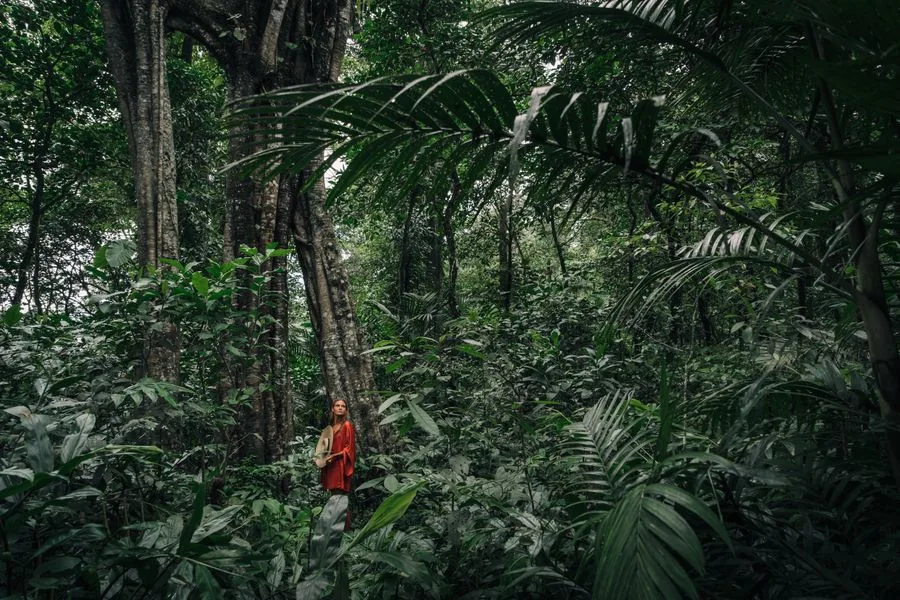
The rainforest's scale hits you first: the heat, the thick green, and the constant noise. But stay a little longer, and the quieter bits begin to surface, and with that you start to see how connected everything is, like a living system.
One forest, several worlds
When you start paying attention, you realise a rainforest is built in layers. Down on the shaded floor and in the understory, it’s dim and damp, because the canopy above catches most of the sunlight. But up in the treetops it’s brighter, windier, and far drier by comparison. So, light, moisture, and height shift with each level, creating very different habitats.
And that’s why staring at the canopy, or fixing your eyes on the trail ahead, means missing a lot. It helps to keep shifting your attention, high, low, and sideways, instead of waiting only for a big wildlife sighting.
Small clues tell bigger stories
Now, onto the small things that you have to pay attention to.
Leaf shapes and textures, fungi on a rotting log, vines looping between trunks, and fallen fruit and fresh tracks in the mud can all be found if you’re paying attention. Each one hints at who or what has been through.
A bromeliad wedged on a branch can hold a small pool of rainwater with tiny creatures living in it. Look down, and fungi help break down fallen leaves and recycle nutrients through the forest.
There are many amazing rainforests out there, but if you are choosing, for instance, a
Costa Rica guided tour, you can combine rainforest experiences with other parts of the country.
Let your ears do some of the work
Indeed, plenty of forest wildlife never shows itself, but that’s not the forest’s fault. Close your eyes, and the experience changes. You can hear calls, rustling leaves, buzzing insects and rain.
A 2026 study of forest soundscapes found tropical forests to be quite complex both by day and by night, with insects playing a significant part.
Essentially, slowing down helps. A lot. If you treat every walk as a race to the next landmark, you’ll miss the whole experience. Also, a good local guide can enhance the experience. They can tell you what that call is and point out signs you’d walk straight past, for example.
Look closely, tread lightly
But keep in mind that all that noticing comes with a responsibility. You have to stick to designated trails, follow guide instructions and, as much as it might pain you to read,
always keep a respectful distance from wildlife.
Even apparently approachable wildlife should be given plenty of space.
It’s also worth learning about local conservation work, so the forest isn’t just a backdrop. Wildlife watching is most rewarding when it doesn’t disturb the animals or their habitat.
Take your curiosity further
This way of looking works well even beyond the rainforest. If you’re taking a coastal path or visiting a city park, they all reward the same slow attention. It really enriches the experience when you leave a little room for the things you weren’t specifically looking for.